
This set
of Basic Electrical Engineering Multiple Choice Questions & Answers (MCQs)
focuses on “Parallel Networks” Set-1.
1. When
parallel resistors are of three different values, which has the greatest
power
loss?
a) The smallest resistance
b) The largest resistance
c) They have the same power loss.
d) Voltage and resistance values are needed.
Answer: A
2. The
voltage across any branch of a parallel circuit:
a) varies as the total current varies
b) is inversely proportional to total circuit
resistance
c) is equally applied to all branch conductance
d) is dropped in proportion to each branch
resistance
Answer: C
4. What
is the total power loss if 2 k and 1 k parallel-connected resistors have an
Current of 3 mA?
a) 6 W
b) 36 W
c) 6 mW
d) 36 mW
Answer: C
Explanation: R= R1 X R2 = 2/3
R1 + R2
Total
Power Loss = I2 x R = 3 x 3 x 2/3 = 6 mW
5. What
happens to total resistance in a circuit with parallel resistors if one of them
opens?
a) It increases.
b) It halves.
c) It remains the same.
d) It decreases.
Answer: A
6. If two
bulbs are connected in parallel and one bulb blows out, what happens to the
other bulb?
a) The other bulb blows out as well
b) The other bulb continues to glow with the same brightness
c) The other bulb glows with increased brightness
d) The other bulb stops glowing
a) The other bulb blows out as well
b) The other bulb continues to glow with the same brightness
c) The other bulb glows with increased brightness
d) The other bulb stops glowing
Answer: b
Explanation: In a parallel circuit, if one
bulb blows out, it acts as an open circuit. Current does not flow in that
branch but it continues to flow in the other branch hence the bulb continues to
glow.
7.
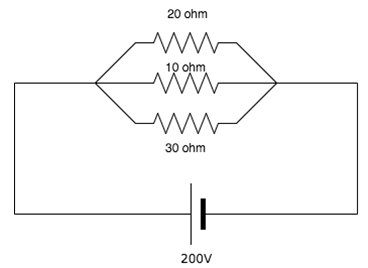
Calculate the current across the 20 ohm resistor.

Answer: a

No comments:
Post a Comment